Hydraulic Decoupling in Modern Heating: Sizing Low-Loss Headers in Pure TypeScript
Eliminating circulator pump conflict, achieving zero differential pressure, and implementing deterministic hydraulic separator sizing in client-side TypeScript.
title: Hydraulic Decoupling in Modern Heating: Sizing Low-Loss Headers in Pure TypeScript subtitle: Eliminating circulator pump conflict, achieving zero differential pressure, and implementing deterministic hydraulic separator sizing in client-side TypeScript. published: true description: Learn how to model primary-secondary hydronic decoupling, eliminate circulator pump conflict, and calculate low-loss header dimensions in pure TypeScript. tags: typescript, webdev, engineering, architecture canonical_url: https://hvaclogic.org/calculators/expansion-tank-calculator cover_image: https://hvaclogic.org/images/social/hashnode-low-loss-header-cover.jpg
In modern hydronic engineering, combining high-efficiency modulating condensing boilers or air-to-water heat pumps with multi-zone variable-speed distribution loops introduces a hydraulic paradox: circulator pump interference.
When variable-speed zone circulators ramp up while the boiler primary pump modulates on its own internal firing curve, connecting them directly in series creates severe hydraulic coupling. The stronger circulator can overcome the weaker circulator, inducing pump cavitation, flow reversal, boiler heat exchanger starvation, and erratic temperature control.
To solve this, mechanical systems rely on a Low-Loss Header (Hydraulic Separator).
In this article, we examine the fluid mechanics of low-loss headers, write a pure, deterministic TypeScript computational engine to size header bodies based on velocity and connection diameters, and verify the model with Vitest invariant tests.
The Physics of Hydraulic Decoupling
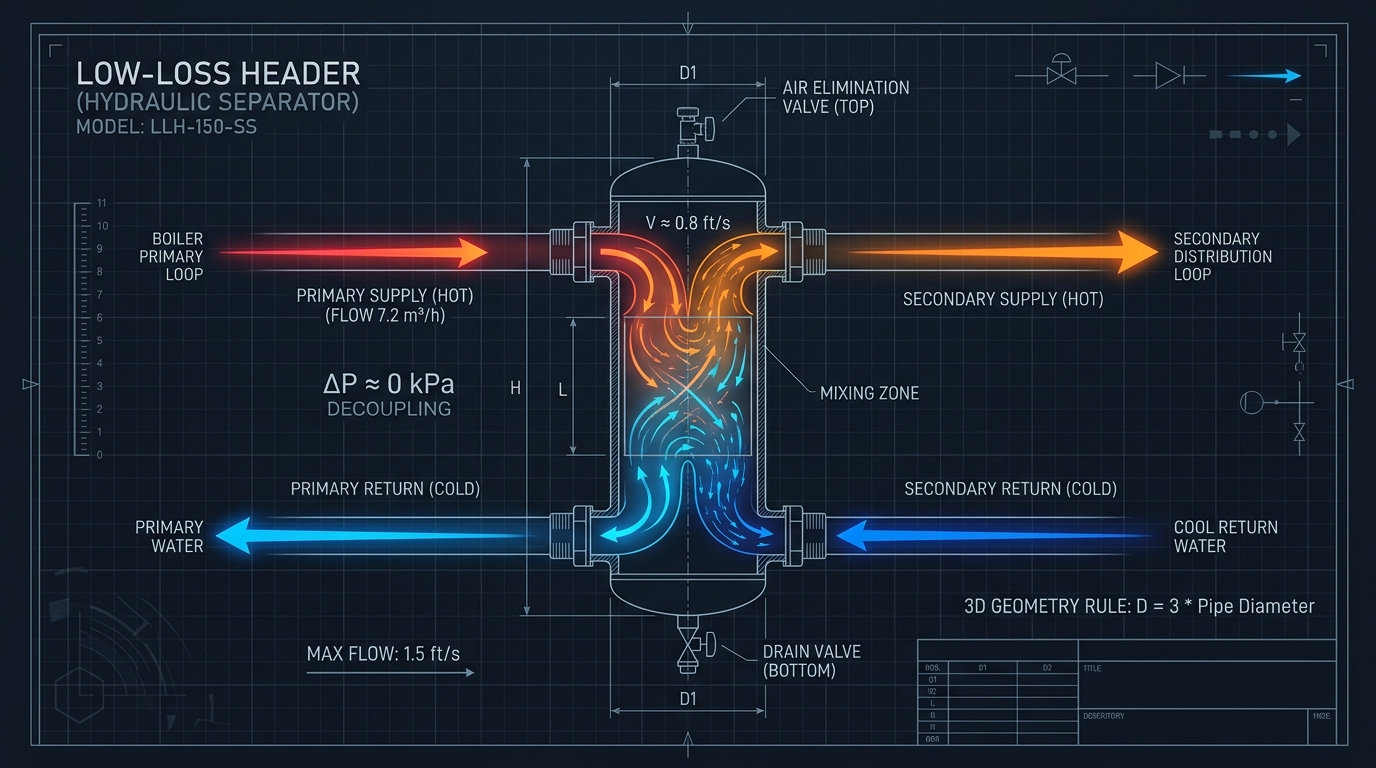
A low-loss header is a vertical vessel with high internal cross-sectional area relative to incoming pipe nozzles. Its function is to establish a point of near-zero differential pressure (\(\Delta P \approx 0\)) between the primary generator loop and secondary distribution loops.
 PRIMARY BOILER LOOP                LOW-LOSS HEADER                SECONDARY ZONE LOOPS
 ┌───────────────────┐              ┌───────────────┐              ┌───────────────────┐
 │                   │   Boiler     │               │   Zone       │                   │
 │ Condensing Boiler ├─────────────►│ Nozzle (d_in) ├─────────────►│ High-Temp Radiator│
 │     Circulator    │   Supply     │               │   Supply     │      Loop         │
 │                   │              │   V <= 1.5    │              │                   │
 │                   │              │     ft/s      │              │                   │
 │                   │   Boiler     │               │   Zone       │ Underfloor Low-T  │
 │                   │◄─────────────┤   ΔP ≈ 0      │◄─────────────┤      Loop         │
 │                   │   Return     │               │   Return     │                   │
 └───────────────────┘              └───────────────┘              └───────────────────┘
Three thermodynamic flow states occur inside the header:
- Balanced Flow (\(Q_{\text{primary}} = Q_{\text{secondary}}\)): All heated water from the boiler passes directly into the heating zones without bypass.
- Excess Generator Flow (\(Q_{\text{primary}} > Q_{\text{secondary}}\)): During low-load zone demand, excess boiler water bypasses downward through the header, raising boiler return temperature and preventing short-cycling.
- Excess Distribution Flow (\(Q_{\text{secondary}} > Q_{\text{primary}}\)): During morning warm-up across all zones, secondary circulators draw return water upward through the header to blend with supply water, maintaining design circulation without starving the boiler.
Governing Engineering Equations
To ensure near-zero pressure drop and allow air bubbles and dirt particles to settle, standard engineering guidelines (such as CIBSE Guide B and ASHRAE Systems and Equipment Handbook) enforce two design constraints:
1. Volumetric Flow Rate ($Q$)
From the sensible heat equation in hydronic loops: $$Q_{\text{gpm}} = \frac{Q_{\text{BTU/hr}}}{500 \cdot \Delta T}$$
Where:
- \(Q_{\text{BTU/hr}}\) is the maximum heating load.
- \(\Delta T\) is the design temperature difference (typically 20°F for condensing boilers, 10°F for heat pumps).
- $500$ is the hydronic constant (\(8.33\text{ lb/gal} \times 60\text{ min/hr} \times 1.0\text{ BTU/lb}\cdot^\circ\text{F}\)).
2. Maximum Header Velocity (\(V_{\text{max}} \le 1.5\text{ ft/s}\))
The internal fluid velocity inside the header body must not exceed 1.5 ft/s (0.45 m/s). The required minimum internal cross-sectional area is: $$A_{\text{sq in}} \ge \frac{Q_{\text{gpm}} \cdot 0.3208}{V_{\text{max}}}$$ $$\text{Diameter}_{\text{min}} = \sqrt{\frac{4 \cdot A}{\pi}}$$
3. The 3D Geometry Rule
To prevent turbulence across opposing nozzles from creating dynamic pressure differentials, the header body diameter must be at least 3 times the nominal diameter of the largest pipe connection: $$\text{Body Diameter} \ge 3 \cdot d_{\text{nozzle}}$$
Implementing the Sizing Engine in TypeScript
Here is our pure, zero-dependency calculation engine:
/**
 * Deterministic Low-Loss Header (Hydraulic Separator) Sizing Engine
 * Implements ASHRAE Systems & Equipment Ch. 15 and CIBSE Guide B principles.
 */

export interface LowLossHeaderInput {
  boilerOutputBtuPerHour: number;
  designDeltaTFahrenheit?: number; // Default 20°F (condensing) or 10°F (heat pump)
  maxInternalVelocityFts?: number; // Standard limit <= 1.5 ft/s
  mainPipeNominalInches: number;   // Largest connecting nozzle diameter
}

export interface LowLossHeaderResult {
  designFlowGpm: number;
  minCrossSectionalAreaSqIn: number;
  minVelocityDiameterInches: number;
  threeDRuleDiameterInches: number;
  recommendedCommercialBodyInches: number;
  actualVelocityFts: number;
  explanation: string;
}

// Standard commercial steel/copper pipe body sizes
const STANDARD_COMMERCIAL_BODY_SIZES = [2.0, 2.5, 3.0, 4.0, 5.0, 6.0, 8.0, 10.0, 12.0];

export function calculateLowLossHeader(input: LowLossHeaderInput): LowLossHeaderResult {
  const btu = Math.max(10000, input.boilerOutputBtuPerHour);
  const deltaT = Math.max(5, input.designDeltaTFahrenheit ?? 20);
  const maxVelocity = Math.max(0.5, input.maxInternalVelocityFts ?? 1.5);
  const nozzleDiameter = Math.max(0.75, input.mainPipeNominalInches);

  // 1. Calculate design flow rate (GPM)
  // Constant 500 = 8.33 lb/gal * 60 min/hr * 1.0 specific heat
  const flowGpm = Number((btu / (500 * deltaT)).toFixed(2));

  // 2. Compute minimum cross-sectional area based on max velocity threshold
  // 1 GPM = 0.002228 cu ft/sec = 0.3208 sq in * ft/sec
  const minAreaSqIn = (flowGpm * 0.3208) / maxVelocity;
  const minVelocityDiameter = Math.sqrt((4 * minAreaSqIn) / Math.PI);

  // 3. Compute 3D Rule threshold: Body Diameter >= 3 * Nozzle Diameter
  const threeDRuleDiameter = nozzleDiameter * 3;

  // 4. Select controlling diameter (governed by the larger of velocity and 3D rule)
  const governingMinDiameter = Math.max(minVelocityDiameter, threeDRuleDiameter);

  // 5. Select closest standard commercial body size that satisfies governing diameter
  const recommendedBody =
    STANDARD_COMMERCIAL_BODY_SIZES.find((size) => size >= governingMinDiameter) ??
    Math.ceil(governingMinDiameter);

  // 6. Compute actual internal velocity in the selected commercial body
  const actualAreaSqIn = (Math.PI * Math.pow(recommendedBody, 2)) / 4;
  const actualVelocity = Number(((flowGpm * 0.3208) / actualAreaSqIn).toFixed(2));

  return {
    designFlowGpm: flowGpm,
    minCrossSectionalAreaSqIn: Number(minAreaSqIn.toFixed(2)),
    minVelocityDiameterInches: Number(minVelocityDiameter.toFixed(2)),
    threeDRuleDiameterInches: Number(threeDRuleDiameter.toFixed(2)),
    recommendedCommercialBodyInches: recommendedBody,
    actualVelocityFts: actualVelocity,
    explanation: `Boiler thermal output of ${btu.toLocaleString()} BTU/hr at ${deltaT}°F ΔT produces ${flowGpm} GPM design flow. Sized to ${recommendedBody}" nominal body (actual velocity: ${actualVelocity} ft/s <= ${maxVelocity} ft/s guideline).`,
  };
}
Vitest Verification Suite
To maintain mathematical safety across production releases, we lock the behavior with Vitest:
import { describe, it, expect } from "vitest";
import { calculateLowLossHeader } from "./low-loss-header";

describe("Low-Loss Header Hydronic Sizing Engine", () => {
  it("calculates 100,000 BTU/hr residential condensing boiler decoupling correctly", () => {
    // 100,000 BTU/hr @ 20°F ΔT -> Flow = 100,000 / (500 * 20) = 10 GPM
    // Nozzle: 1.0" pipe -> 3D Rule requires at least 3.0" body
    const res = calculateLowLossHeader({
      boilerOutputBtuPerHour: 100000,
      designDeltaTFahrenheit: 20,
      mainPipeNominalInches: 1.0,
      maxInternalVelocityFts: 1.5,
    });

    expect(res.designFlowGpm).toBe(10);
    expect(res.threeDRuleDiameterInches).toBe(3.0);
    expect(res.recommendedCommercialBodyInches).toBe(3.0);
    expect(res.actualVelocityFts).toBeLessThanOrEqual(1.5);
  });

  it("handles low-temperature heat pump loops with high flow rate (10°F ΔT)", () => {
    // 60,000 BTU/hr heat pump @ 10°F ΔT -> Flow = 60,000 / (500 * 10) = 12 GPM
    const res = calculateLowLossHeader({
      boilerOutputBtuPerHour: 60000,
      designDeltaTFahrenheit: 10,
      mainPipeNominalInches: 1.25,
      maxInternalVelocityFts: 1.5,
    });

    expect(res.designFlowGpm).toBe(12);
    expect(res.threeDRuleDiameterInches).toBe(3.75);
    expect(res.recommendedCommercialBodyInches).toBe(4.0);
    expect(res.actualVelocityFts).toBeLessThan(0.5);
  });
});
Integration in System Design
Hydraulic decoupling is not isolated from the rest of the mechanical room. When secondary circulators modulate, pressure transients still transfer to the system's expansion volume.
To size the corresponding ASME bladder tank and verify thermal acceptance schedules for decoupled loops, explore the interactive ASHRAE Hydronic Expansion Tank Calculator. For comprehensive hydronic design benchmarks and heat pump balance curves, review our Heating Systems Engineering Hub.
All models run 100% in the client browser with zero server data storage.
About the author
- Mechanical engineer and software architect building deterministic, 100% client-side calculation engines for building science, fluid dynamics, and thermodynamic diagnostics. Creator of [HVACLogic](https://hvaclogic.org), an open-access engineering suite featuring zero-database architecture, zero tracking, and pure TypeScript mathematical physics (Colebrook-White fluid dynamics, ASHRAE Hyland-Wexler psychrometrics, and A2L refrigerant phase equilibrium).
Comments
Join the discussionNo comments yet. Be the first to comment.
Open Energy Modeling in TypeScript
Deterministic building science, fluid dynamics, and thermodynamic simulation in pure client-side TypeScript with zero database and total privacy.